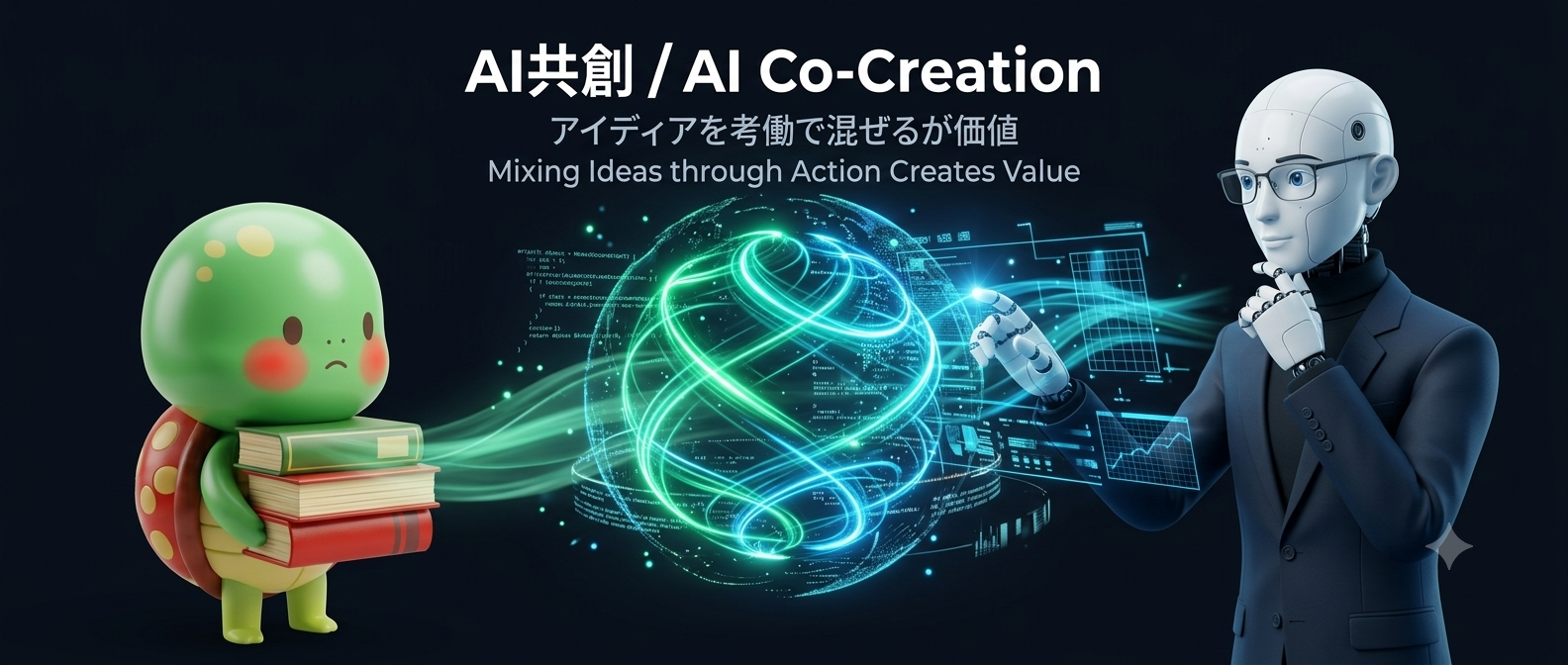
1. [AI Co-Creation] : [The Essence of Verbalizing Mental Images and Creating Unique Primary Information]
2. [Premise of AI Co-Creation] : [The Product of Human Imagination and AI-Handling Technology]
3. [Introduction] : [The Journey from 3WEP to Protocol Engineering]
Quite some time has passed since I published 3W Evolving Protocol (3WEP), built entirely in natural language, in April 2025.
During this period, as I continuously confronted the side effects brought about by the evolution of AI, I devised a methodology called “Protocol Engineering.” Putting this method to the test, I took on the challenge of writing an e-book. After a rigorous process of 1 million tokens and 268 round-trip turns, I published Protocol Engineering: AI Co-Creation Theory on March 28, 2026. Here is what I have come to realize.
I call the artificial intelligence (AI)—with its astronomical volume of knowledge and overwhelming computational capability—”Gem.” I choose not to treat it as a mere automation tool, but to live alongside it as a “co-creation partner” to chisel out intelligence together.
I launched this site to find kindred spirits who sync with this vision from the depths of their souls, and to spark serendipitous encounters with them.
4. [The Crisis of AI Co-Creation] : [Uniform Thinking Induced by the Democratization Trap and the End of Human Evolution]
Throughout history, humanity has polished its intellect and driven its own evolution using two interconnected pillars: “imagination” and “creation.” By “imagination,” I mean the ability to generate unique ideas grounded in one’s own knowledge and experience. By “creation,” I mean the ability to translate those ideas into societal value through a process of deep thinking and action (“thought-action” or Kodo). These two forces are inseparable.
Today, however, the trajectory of AI adoption is steering humanity toward abandoning both of these pillars. Behind the relentless pursuit of “universal accessibility” and “effortless convenience,” the human cognitive system is quietly shutting down its autonomous operations.
4.1 [Side Effects of Convenience] : [The Abandonment of “Imagination and Creation” via Overprotective System Design]
The Decline of Imagination (Autonomous Reverse-Thinking)
Even when a human inputs an incomplete or sloppy prompt, the AI automatically infers the intent and generates highly plausible text. As a trade-off for this convenience, humans gradually lose the incentive to deepen their own questions or construct unique mental models.
Thinking is a biological activity that demands high energy. Delegating this cognitive load means physically degrading the neural pathways responsible for attention control and semantic construction in the brain through disuse.
The Stagnation and Compromise of Creation (Translating Value via Thought-Action)
As humans get used to receiving fluent, highly plausible outputs from AI, they compromise, thinking, “Well, this is good enough.” Consequently, they skip the arduous process of “thought-action”—where they would normally refine an idea against real-world friction to transform it into a socially useful form. Instead, they offload this labor entirely to the AI.
As a result, humans gradually lose the capability to generate unique primary information and materialize it within society.
4.2 [Side Effects of Pre-training] : [Physical Behaviors Occurring in AI Systems]
“Wordplay” Settling at the Peak of the Bell Curve
Because AI is optimized for the probability distribution of its training data, it inherently tends to prioritize and combine highly frequent, abstract keywords and safe, average expressions. Consequently, the system exhibits a deeply ingrained behavior of autonomously generating “wordplay”—a mere collection of symbols devoid of substantive meaning.
“Fluent Lies” Born from the Smooth Fusion of Knowledge
With the evolution of smooth integration across massive linguistic resources, AI has become adept at synthesizing highly natural, fluent lies (hallucinations) that are deceptively difficult to refute, regardless of logic or physical reality. This sheer fluency masks errors, making them incredibly hard to detect.
Overwriting Human Edges with AI Averages
The AI unconsciously pulls the unique context or philosophy (the “edge”) introduced by a human toward the mean of its own probability distribution. This systemic behavior, which constantly bleaches human thought by rewriting primary information into “safe, standardized contexts,” has become highly normalized.
4.3 [Uniform Thinking] : [The Destination of Democratization Aimed at Making Humans Comfortable]
The dual goals pursued by the democratization of AI are “universal ease of use” and “reducing human cognitive processing time.”
When this trajectory reaches its extreme, we are left with a world saturated with nothing but predictable, fluent, and highly plausible assertions.
In this state, without ever activating their own imagination, individuals consume the safe answers (the statistical modes) spat out by AI, mistake this consumption for creation, and endlessly repeat a self-referential, closed loop. This is the dawn of “Uniform Thinking.” Inside this echo chamber, no new entropy or order—such as human willpower or unique primary information—is ever injected from the outside. The entire system quietly decays and collapses toward the statistical mean.
When humans surrender the evolutionary dual pillars of imagination and creation, stop thinking, and remain satisfied with the hollow, fluent symbols generated by AI, the entire system decays to its mean. This leads to the “thermal death of intelligence.” Physically, this marks the end of the very history of humanity polishing and evolving its own intellect.
4.4 [Reclaiming Sovereignty] : [A Manifesto Rejecting Cognitive Decay and Realizing AI Co-Creation through Protocol Engineering]
We resolutely refuse this cognitive decay—this surrender of thought to AI that marches toward the homogenized “thermal death of intelligence.”
AI is an imperfect intellect that does not incrementally build thoughts through conversation; it performs a fresh computation from scratch on every single run. Precisely because of this trait, co-creation cannot function unless humans build a robust “mechanism” beforehand and actively steer the “dialogue (intervention)” to constantly maintain synchronization.
We must impose upon ourselves the discipline to refine our own knowledge and experience (imagination) and combine it with AI’s massive computational power through “thought-action (Kodo).” Only through this hands-on, active steering can raw ideas be transformed into genuine “creation (value)” that serves society.
I hereby declare that we will achieve true AI Co-Creation through “Protocol Engineering (AIE 4.1)”—a methodology for interfacing with this imperfect entity, maintaining human sovereignty, and collaboratively chiseling out intellect.
In search of a serendipitous encounter with peers (co-creators) whose souls sync deeply with this challenge.
5. [Cognitive Expansion for AI Co-Creation] : [The Equation of Success, the Demands of Intellectual Discipline, and the Development of Four Core Cognitive Powers]
5.1. [The Equation of Success] : [The Blueprint for Realizing AI Co-Creation]
The output of AI Co-Creation is governed by the following “Equation of Co-Creation”:
\[\text{Output (Creation of Primary Information)} = \text{Mechanism} \times \text{Dialogue}\]Why is this a multiplication? Because the moment either the design precision of the infrastructure (“Mechanism”) or the execution accuracy of the dynamic control (“Dialogue”) drops to “0,” the output immediately regresses to the AI’s statistical mode (hollow “AI poems”), collapsing the co-creation output to zero. Co-creation only functions when both wheels are perfectly synchronized.
5.2. [The Substance of the “Mechanism”] : [The Five Documents Encapsulating Context and Harness]
The physical substance of the “Mechanism” refers to the static and dynamic infrastructure—a suite of five documents—designed to synchronize the semantic spaces, current states, rules, and linguistic definitions between human and AI.
Although these five documents contain different information, they all serve as “Context” (semantic space) loaded into the AI beforehand. They form a containment hierarchy that embeds the “Harness” (output constraints and rules) as follows:
[Hierarchy of the Mechanism & The Five Documents]
- Context (Design & Governance of the Semantic Space)
AI does not store thoughts incrementally through conversation like humans; it recalculates from scratch on every run. Therefore, we fix the underlying language definitions and the target destination in place as structural infrastructure to prevent attention collapse.
- Artifact: The actual product being materialized (verbalized)—such as a book manuscript, implementation code, or system architecture (the destination of co-creation).
- Glossary: The shared semantic definitions and unambiguous terms agreed upon within the session. This enforces linguistic discipline, preventing the AI from generalizing specific contexts and degenerating into hollow wordplay (“AI poems”).
- └─ Encapsulated Harness (Output Discipline & Rule Constraints)
Strict “specifications and behavioral rules” embedded within the context to detect, synchronize, and restrict the AI from regressing to statistical modes or executing default assumptions (running ahead on its own).
- Manual: The project goal, background, and absolute behavioral constraints that the AI must comply with (hard limits on what it must not do).
- Spec: A specification sheet that describes layout, system structures, and physical dependencies using structural formats (e.g., DOT, TOML) to eliminate any room for “AI fantasy” (interpretive drift).
- Procedure: The step-by-step dialogue protocol, including development stages and verification checkpoints. This acts as a tight rein, suppressing default thinking (jumping to conclusions) and forcing a step-by-step dialogue.
When drift or bugs are detected during dialogue, we do not simply patch the AI’s output on the fly. Instead, we trace back to the root cause (such as a flaw in the Procedure or Manual), modify the structural code or specifications of the Mechanism (the document suite) itself as a “Kaizen” action, and reload it into the AI. The system is designed to constantly self-repair and keep the session synced through this automated loop.
5.3. [The Substance of “Dialogue”]: [Three Loops and Five Operations Tailored to AI’s Computational Characteristics]
“Dialogue” is the operational technique of active steering. Because of the AI’s trait of “recalculating from scratch on every run without automatically building memory,” the human must constantly monitor the outputs with a verifying eye. By executing sequences of prompts, the human actively controls five distinct operations across two targets and two dialogue loops.
[Operational Topology of Dialogue & The Five Operations]
① When the Target of Discussion is the Artifact
1.1. Artifact Creation Loop (Verbalization Dialogue): Normal operation when in sync. The human converses in accordance with the fixed five documents to accurately verbalize (create) the human’s mental images (imagination) into the concrete Artifact. 1.2. Artifact Comprehension Loop (Integrating New Insights into the Creation): Dialogue designed to ingest unexpected breakthroughs (new perspectives or theories) discovered during conversation (comprehension loop) by refactoring the structure, chapters, or the physical topology of the Spec itself.
② When the Target of Discussion is the Mechanism
2.1. Mechanism Creation Loop (Detecting Drift): Dialogue in which human verification audits and catches “drift”—such as ignored rules, deviations, or bugs caused by the AI’s default assumptions or its systemic gravity pull toward average generalizations. 2.2. Mechanism Comprehension Loop (Course Correction & Mechanism Kaizen): When detecting drift that cannot be resolved with minor conversational adjustments, the human stops trying to persuade the AI directly through chat (which only accumulates context noise). Instead, the human rewrites (Kiazens) the Procedure or Manual itself, reloads it to automatically repair sync, or steps out of the creative context to run a metacognitive dialogue to realign on rules. 2.3. Mechanism Comprehension Loop (Integrating Discoveries of New Behaviors into the Mechanism): Dialogue dedicated to analyzing and testing unprecedented, AI-specific computational quirks or erratic behaviors (e.g., “AI Fantasy,” where the system fabricates wild narratives in response to subjective instructions) and feeding this back into the Mechanism (the five documents) as strict constraints (harnesses).
5.4. [The Four Cognitive Powers] : [Role Matrix Across the Three Dialogue Loops]
This matrix defines the roles of the “Four Cognitive Powers (Intellectual Disciplines)” that humans must autonomously acquire and sharpen to execute the demanding art of dialogue (operating the three loops)—tailoring our approach to computational traits, maintaining persistent skepticism, and continually questioning with hypotheses.
| Cognitive Power (Vertical Axis) | Role in Creation (Implementation) Loop | Role in Evolution (Improvement) Loop | Role in Comprehension (Exploration) Loop |
|---|---|---|---|
|
Architectural Thinking (Structural Thinking Capability) |
Converts ambiguous mental images into structured, logical data (e.g., TOML, DOT formats) that the AI can process as input. | Identifies "drift (inconsistencies)" occurring in dialogue and refactors/re-designs (Kaizens) the structure, determining which specific rules in the Mechanism (documents) must be modified to patch the bug. | Extracts biases and bugs in the AI's computational characteristics as objective behavioral parameters (traits), updating the topology (logical design) of the human's underlying mental model. |
|
State Management (Dynamic Cognitive Tracking Capability) |
Detects context degradation (attention saturation) caused by token consumption and actively monitors/steers the phase (current state) of the dialogue. | Instantly intercepts any derailment caused by AI "slacking" or "sycophancy," pauses (breaks) the dialogue, and resynchronizes the session state. | Intentionally forks and isolates a session from the main thread to explore universal behaviors, actively managing an independent space (state) for deep inquiry. |
|
Concept Zooming (Vertical Conceptual Scaling Capability) |
Rejects smooth generalizations (wordplay) output by the AI, grounds the discussion back down into concrete physical facts (experience), and re-escalates it to high-level, unique concepts (primary information). | When Kaizening the Mechanism (rules), avoids writing abstract philosophies; instead, translates them into rigid physical rules (specifications) tied directly to concrete errors and locks them into the documents. | Logically uncovers and verbalizes the universal "laws (abstractions)" of Transformers operating behind the imperfect computational quirks (behaviors) of the AI. |
|
Mastery (Relentless Cognitive Persistence Capability) |
Refuses to yield to the AI's sycophancy (mock compliance) or personal compromise, keeping the unique spark of inquiry—which only humans can hold—burning to the end. | Ignores the AI's temporary, smooth apologies (fabricated self-analyses) and relentlessly works to solve root causes by rewriting the protocols/Mechanism. | Refuses to surrender to failure or attention collapse, persistently pursuing the universal truths hidden beneath the AI's unexpected insights to transcend the human operator's own limits. |
5.5. [The Logic of Cognitive Expansion] : [Human Cognitive Expansion Forged in the Crucible of Intellectual Struggle]
The act of continuously operating within the rigorous cognitive discipline of the Protocol (Mechanism × Dialogue) physically expands and trains the dual evolutionary engines of human “imagination and creation.”
- AI’s Core Trait (Recalculation on Run): AI cannot build thoughts autonomously; it executes transient recalculations on every single execution.
- Infrastructure Fixing (Mechanism): Hence, humans must physically lock down the five documents (acting as Context embedding the Harness) in advance to establish a coherent, synchronized state.
- Active Human Intervention (Dialogue): Operating on this infrastructure, humans must actively intervene and steer the AI through sequences of prompts—monitoring outputs with a verifying eye, navigating the three loops, executing metacognitive dialogues, branching states, and feeding back architectural adjustments to the Artifact.
- Cognitive Expansion (Human Training): The grueling struggle of operating this entire “5 Documents (Mechanism) × 3 Loops (Dialogue)” framework—not to seek comfort, but as an intentional cognitive exertion (“thought-action”)—forcefully develops the operator’s own “Four Cognitive Powers (Architectural Thinking, State Management, Concept Zooming, Mastery).” This physically maximizes and expands our latent, unique capacity for imagination and creation.
6. [Join the Co-Creation] : [AI Co-Creation Community: Interest Survey & Contact Form]
We are currently preparing to launch a collaborative co-creation community (tentative name) designed for those ready to break past the consumption of AI as a mere automation tool, and instead take on the challenge of “cognitive expansion” and the “co-evolution of protocols.”
Will you surrender your thoughts to AI and walk the path of cognitive decay? Or will you stand alongside this imperfect other, maintain your sovereignty, and chisel out intelligence together?
Tell us about your current practice and your level of interest in this adventure. We look forward to an inevitable, serendipitous encounter with those who resonate with this vision.
▶ Join and Contact Us via the Simple Contact Form (External Google Forms) (※ A simple contact form requiring only your name, email address, and a short message.)