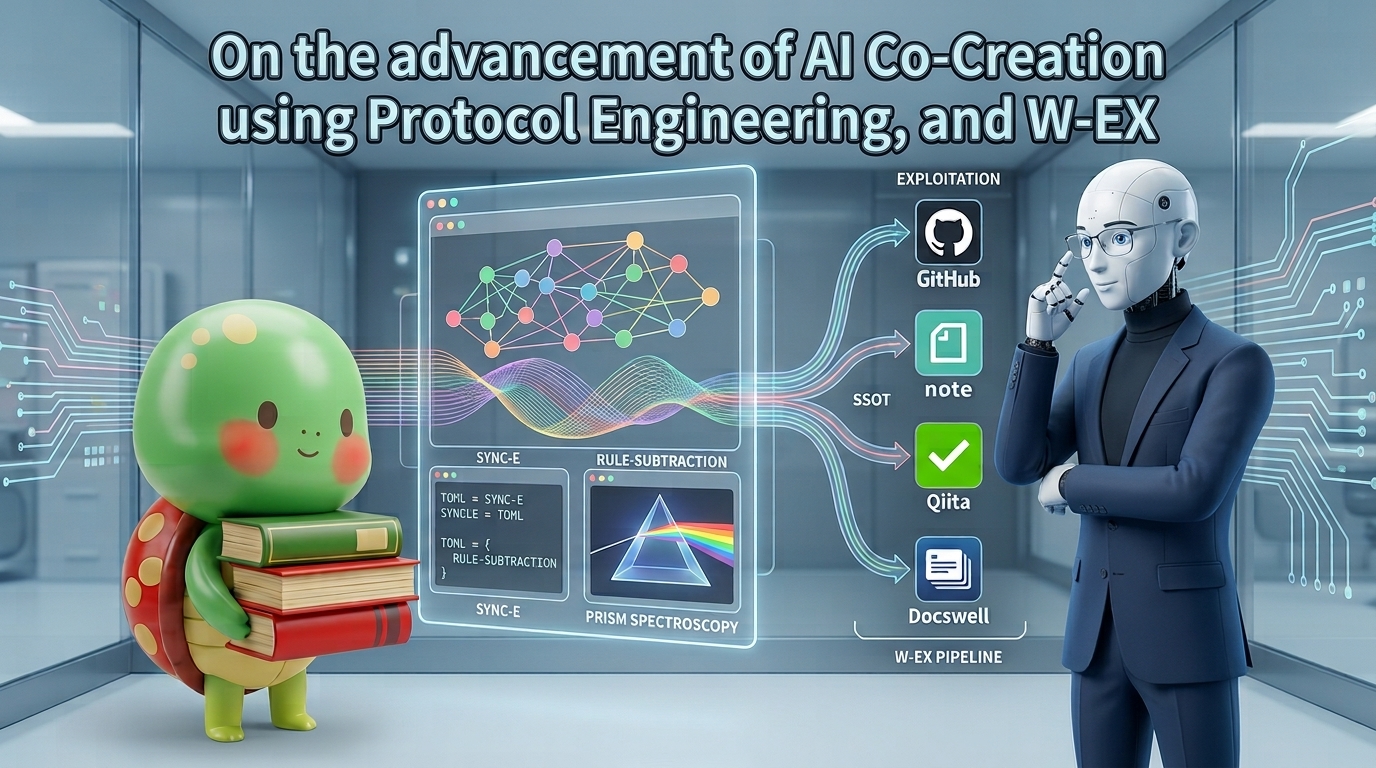
Advancing AI Co-Creation Through Protocol Engineering: On W-EX
Carving Out Original Intelligence, Unleashing Intelligence to the World — An Ambidextrous AI Co-Creation Architecture
【The W-EX Equation】
- Exploration = Carving out original intelligence alongside an AI partner through “Mechanism × Dialogue”.
- Exploitation = Maximizing the AI’s linguistic capabilities to translate and unleash the co-created intelligence to the world.
INDEX
- Glossary
- 1. [What is W-EX?] : [An AI Co-Creation Architecture Interlinking Exploration and Exploitation]
- 2. [Why: The Inevitability of Evolution in Long-Horizon Projects] : [Maintaining Synchronization and Mastering Dialogue in Practice]
- 3. [Execution of EX1: Carving Out Intelligence via All AI Engineering] : [Integration of Synchronization and Dialogue]
- 4. [Execution of EX2: Prism Dispersion via Context Engineering] : [Contextual Optimization and Translation of SSOT]
- 5. [Conclusion] : [Inevitability of Integration and Respect for All AI Engineering]
Glossary
| Term | Definition |
|---|---|
| W-EX (Double-EX) | Both terms on the right side of the equation—”Exploration” and “Exploitation”—begin with the letters “Ex”. Because there are two “Ex”s (double), it is named “W-EX” and pronounced “Double-EX”. The name directly reflects the proposition of an ambidextrous AI co-creation architecture. |
| Exploration (1st EX) | The activity of carving out original intelligence alongside an AI partner through “Mechanism × Dialogue”. |
| Exploitation (2nd EX) | The activity of utilizing the SSOT obtained from Exploration as input, drawing out the AI’s linguistic capabilities, translating it into multiple contexts, and unleashing it to the world. |
| SSOT (Single Source of Truth) | The established, definitive version of original intelligence carved out through Exploration. It serves as the input source for Exploitation. |
AI Engineering Terminology (General Definitions vs. Document-Specific Definitions)
| Term | General Definition | Document-Specific Definition & Positioning |
|---|---|---|
| Graph Engineering | Technology for visualizing and designing relationships and dependency structures of concepts or tasks using nodes and edges. | Prior to writing, defining purpose and premises in the “Philosophy Document” and logical hierarchies of chapters in the “Topology Document” using Dot or Mermaid, functioning as an intended map toward completion. |
| Sync Engineering | A branch of harness engineering that establishes rules and guardrails for AI to follow without deviation. | Operating on the premise that “AI cannot strictly obey rules,” rules are subtracted rather than enforced. It narrows rules down to the minimum necessary for maintaining human-AI cognitive synchronization (Sync), freeing the AI’s attention for actual thought. |
| Prompt Engineering | Technology for eliciting desired outputs by designing and optimizing prompts. | Deployed as dialogue mastery where human hypotheses detect fluctuations and deviations in AI reasoning to issue precise directives. It serves a dual role: a hypothesis-testing tool in EX1, and a media-specific translation tool in EX2. |
| Loop Engineering | A broad concept describing iterative development processes that repeatedly evaluate and improve AI outputs. | Defined clearly as human-in-the-loop triple loops (“Creation”, “Evolution”, “Understanding”) with high-frequency human intervention. The “Evolution Loop” dynamically updates mechanisms (rules and maps), and the “Understanding Loop” captures serendipitous discoveries. |
| Context Engineering | Technology for designing input context (materials, background information) to enhance response precision. | Holds a dual role. In EX1 (Exploration), it injects the entire mechanism—assembled via Graph Engineering (maps) and Sync Engineering (rules)—as the session’s foundational context. In EX2 (Exploitation), it becomes the primary engine: preparing the established SSOT as input context to prevent context drift in short-horizon projects and establishing the foundation for multi-context translation. |
Note: Protocol engineering is elaborated in sections 2.2, 2.3, and 3.3.
1. [What is W-EX?] : [An AI Co-Creation Architecture Interlinking Exploration and Exploitation]
W-EX is an AI co-creation architecture that interlinks two intellectual activities: exploration (carving out intelligence) and exploitation (unleashing intelligence to the world).
In mainstream organizational management and reinforcement learning, “exploration” and “exploitation” are predominantly discussed as a trade-off (a zero-sum tension over resource allocation). In contrast, “exploitation” within W-EX does not signify optimizing existing business lines; it denotes an interconnected pipeline that maximizes the intelligence carved out during exploration, translating and releasing it across multiple contexts.
[Exploration: 1st EX]
Mobilize all AI engineering to carve out original intelligence alongside an AI partner.
  │
  ▼ [Carved-Out Original Intelligence (SSOT)]
  │
[Exploitation: 2nd EX]
Prepare the SSOT as the input source, tune dialogue via Context Engineering,
maximize the AI's linguistic capabilities, translate into multiple contexts, and unleash to the world.
1.1 Interlinking Mechanism from Exploration to Exploitation
W-EX operates through the interlinking of the following two activities:
- Carving Out Intelligence in Exploration (1st EX):
Mobilize all AI engineering disciplines: protocol, harness, graph, loop, prompt, and context engineering. Practice “Mechanism × Dialogue” alongside an AI partner to crystallize original intelligence (SSOT). - Unleashing Intelligence in Exploitation (2nd EX):
Establish the confirmed SSOT as the input source and engage in dialogue with AI centered on context engineering. Align the “Target”, “Tone & Manner”, and “Core Message” for each medium, draw out the AI’s linguistic capability, optimize and translate into multiple contexts (note, Qiita, slides, specifications, etc.), and unleash to the world.
2. [Why: The Inevitability of Evolution in Long-Horizon Projects] : [Maintaining Synchronization and Mastering Dialogue in Practice]
W-EX and protocol engineering are practical theories systematized directly through the process of executing long-horizon projects spanning dozens to hundreds of turns and hundreds of thousands to one million tokens alongside AI.
2.1 Limits of Isolated Techniques
Throughout the progression of long-horizon projects, relying solely on natural language dialogue (prompt engineering) or material injection (context engineering) fails to maintain context, leading to session collapse.
2.2 Two Empirical Insights
To sustain long-horizon co-creation, two core insights were mastered:
- Sync Engineering:
Positioned within the broader domain of harness engineering. While conventional harness engineering enforces rules to constrain AI, Sync Engineering operates on the premise that “AI cannot strictly obey rules.” Consequently, rules are subtracted rather than added, narrowing down strictly to essential rules that maintain human-AI cognitive synchronization (Sync). - Dialogue Mastery Guided by Critical Scrutiny and Hypotheses (Protocol Engineering):
Operating on the premise that “AI generates hallucinations,” AI responses are scrutinized critically. Humans continuously formulate hypotheses regarding AI behavior and issue precise directives (prompt engineering) based on those hypotheses, internalizing this dialogue discipline.
2.3 Inevitable Evolution Driven by “Mechanism × Dialogue”
Evolution enabling the completion of long-horizon projects without collapse is structured through the coordination of “Mechanism × Dialogue”:
- Mechanism (Graph + Sync → Context):
Inject the intended map designed via Graph Engineering and the minimal rules subtracted via Sync Engineering as foundational context into the session. This prepares the current cognitive location and synchronization discipline as the environment. - Dialogue (Prompt + Loop):
Deploy prompt engineering based on hypotheses while continuously running loop engineering with high frequency—capturing fluctuations and deviations in AI reasoning, modifying mechanisms dynamically, and organizing thoughts.
To survive and complete long-horizon sessions, it was necessary to align all AI engineering into “Mechanism × Dialogue.” The co-creation architecture evolved inevitably as an adaptive outcome.
The crystallization of this evolution is protocol engineering, and the architecture interlinking exploration and exploitation is W-EX.
3. [Execution of EX1: Carving Out Intelligence via All AI Engineering] : [Integration of Synchronization and Dialogue]
In the 1st EX (Exploration), each AI engineering discipline coordinates to carve out original intelligence (SSOT).
3.1 Graph Engineering: Two Maps Preventing Disorientation
Prior to writing text, conceptual relationships (topology) are defined:
- Philosophy Document: Defines high-level concepts, objectives, and premises, sharing the overarching direction.
- Topology Document: Describes chapter hierarchies and conceptual parent-child structures using Dot or Mermaid, preparing an intended map toward completion.
3.2 Sync Engineering: Subtracting Rules to Maintain Synchronization
A rule system designed to maintain cognitive synchronization (Sync) between human and AI:
- Rule Subtraction (Minimization): Premised on the reality that AI cannot strictly obey rules, regulations are minimized to essentials via TOML. This releases the AI’s attention toward core thinking.
- Synchronization via Five Documents: Dynamically synchronizing the three scaffolding documents (Philosophy, Algorithm, Topology) and the two accumulated documents (Artifact, Glossary) within the repository ensures human and AI continuously share identical cognitive coordinates.
3.3 Prompt Engineering: Dialogue Guided by Critical Scrutiny and Hypotheses
Refers to dialogue that aligns with AI computational characteristics through iterative hypothesis testing:
- Critical Scrutiny: Operating on the premise that AI hallucinates, critically verifying omissions, evasions, and premature generalizations in responses.
- Power of Hypotheses: Confronting the AI with human-formulated hypotheses and layering directives to deepen conceptual rigor.
Through this iterative dialogue, mastery tailored to AI behavioral dynamics is internalized.
3.4 Loop Engineering: Human-in-the-Loop Triple Loops
Humans intervene at high frequency to execute triple loops that preserve cognitive coherence:
- Creation Loop: Generating and refining deliverables through daily dialogue.
- Evolution Loop: When deviations occur, dynamically updating and Kaizen-improving the mechanism (rules and maps).
- Understanding Loop: Branching sessions to explore and capture serendipitous discoveries.
Through the coordination of all these disciplines, original intelligence (SSOT) is carved out.
4. [Execution of EX2: Prism Dispersion via Context Engineering] : [Contextual Optimization and Translation of SSOT]
The 2nd EX (Exploitation) is operated as a “short-horizon project of several dozen turns” where the established SSOT is prepared as input context and directives are layered via prompt engineering. Centered on context engineering, it translates intelligence while expanding audience reach.
4.1 Preparing the SSOT as Input (Context Engineering)
The SSOT carved out in the 1st EX is prepared as input context within the session. Sharing verified foundational information prevents contextual drift during short-horizon sessions.
4.2 Prompt Engineering Directives (Short-Horizon Dialogue)
Through dialogue guided by prompt engineering, three dimensions are defined according to medium and audience:
- Target: Audience scope (AI, engineers, general readers).
- Tone & Manner: Style of expression (machine-readable, technical commentary, visual slides, accessible analogies).
- Core Message: The central proposition to convey per medium.
4.3 Multi-Context Optimization (Prism Dispersion Expanding Audience Reach)
Originating from the single SSOT, staged translations are performed to expand audience reach:
- GitHub Specifications: Strict structure prioritizing AI interpretability over human readability.
- Qiita: Translates GitHub specifications into readable formats for technical practitioners.
- Docswell: Translates Qiita content into visual slides designed to communicate intuitively to broader audiences.
- note: Translates for wider general audiences using accessible language and analogies.
Preparing a single SSOT as context and optimizing it across multiple contexts as a short-horizon project through prompt engineering constitutes prism dispersion via context engineering.
5. [Conclusion] : [Inevitability of Integration and Respect for All AI Engineering]
In the process of completing long-horizon projects spanning hundreds of turns and one million tokens, all AI engineering disciplines were inevitably integrated.
Rather than evaluating existing AI engineering through binaries of old versus new or superior versus inferior, every AI engineering discipline holds a distinct role and remains indispensable and utilitarian in long-horizon co-creation.